• moved by
896 views
15 15 votes

Let $S_{1}$ be the plane figure consisting of the points $(x, y)$ given by the inequalities $\mid x - 1 \mid  \leq 2$ and $ \mid y+2 \mid \leq 3$. Let $S_{2}$ be the plane figure given by the inequalities $x-y \geq -2, y \geq 1$, and $x \leq 3$. Let $S$ be the union of $S_{1}$ and $S_{2}$. The area of $S$ is.

  1. $26$
  2. $28$
  3. $32$
  4. $34$

1 Answer

Best answer
19 19 votes

For $'S_1'$ plane

1. $|x - 1| \le 2$

      A.  when $(x-1) \ge0 \Rightarrow x \ge 1$ 

           Then $+(x - 1) \le 2 \Rightarrow x \le 3$     $\{$ here $(x \ge 1) \cap (x \le 3) \Rightarrow 1 \le x \le 3 \}$

      B. When $(x -1) < 0 \Rightarrow x < 1$

          Then $-(x - 1) \le 2 \Rightarrow x \ge -1$      $\{$ here $(x <1) \cap (x \ge -1) \Rightarrow -1 \le x < 1 \}$

Union $(A \cup B) \Rightarrow -1 \le x \le 3$

2. $|y + 2| \le 3$

      A.  when $(y+2) \ge0 \Rightarrow y \ge -2$ 

           Then $(y + 2) \le 3 \Rightarrow y \le 1$     $\{$ here $(y \ge -2) \cap (y \le 1) \Rightarrow -2 \le y \le 1 \}$

      B. When $(y+2) < 0 \Rightarrow y < -2$

          Then $-(y+2) \le 3 \Rightarrow y \ge -5$    $\{$ here $(y <-2) \cap (y\ge -5) \Rightarrow -5 \le y < -2 \}$

Union $(A \cup B) \Rightarrow -5 \le y \le 1$

So,  $ 'S_1'$  plane will be for intervals : $ -1 \le x \leq 3  \text{ and } -5 \le y \leq 1$
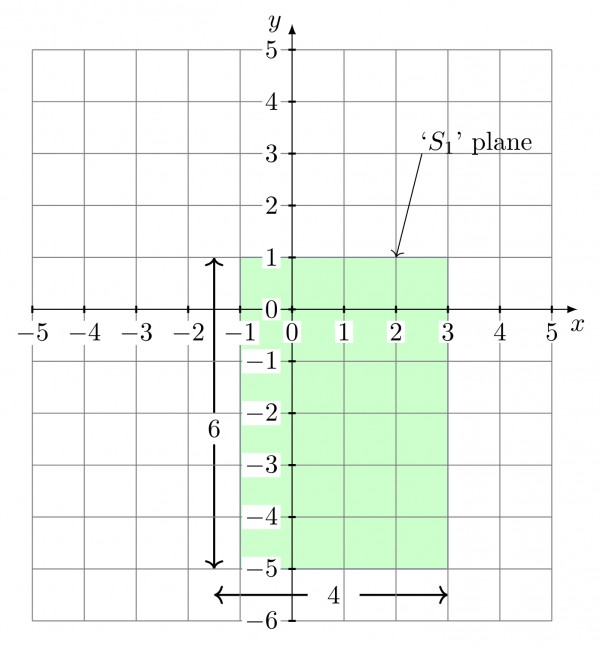
For $'S_2' $plane ,

1. $x - y \ge -2 \Rightarrow y \le x +2$

2. $y \ge 1$

3. $x \le 3$

Here, $S = S_{1} \cup S_2$

So, Area of $S=$  Area of $S_1$ $+$ Area of $S_2$

$\Rightarrow$ Area of $S = 6*4 + \frac{1}{2}*4*4$

$\Rightarrow$ Area of $S= 24 + 8$

$\Rightarrow$ Area of $S= 32$

So, Answer is (C)

• moved by

Related questions

7 7 votes
4 answers 4 answers
1.3k
1.3k views
go_editor asked Mar 1, 2021
1,316 views
The ratio of the area of the inscribed circle to the area of the circumscribed circle of an equilateral triangle is ___________$\frac{1}{8}$$\frac{1}{6}$$\frac{1}{4}$$\fr...
14 14 votes
3 answers 3 answers
1.4k
1.4k views
Arjun asked Feb 26, 2017
1,412 views
A right-angled cone (with base radius $5$ cm and height $12$ cm), as shown in the figure below, is rolled on the ground keeping the point $P$ fixed until the point $Q$ (a...
6 6 votes
2 answers 2 answers
1.1k
1.1k views
gatecse asked Feb 22, 2021
1,070 views
In the above figure, $\textsf{O}$ is the center of the circle and, $\textsf{M}$ and $\textsf{N}$ lie on the circle. The area of the right triangle $\textsf{MON}$ is $50\;...
7 7 votes
1 answers 1 answer
563
563 views
Arjun asked Feb 17, 2018
563 views
A rectangle becomes a square when its length and breadth are reduced by $10$ m and $5$ m, respectively. During this process, the rectangle loses $650 m^2$ of area. What i...

Related questions

7 7 votes
4 answers 4 answers
1.3k
1.3k views
go_editor asked Mar 1, 2021
1,316 views
The ratio of the area of the inscribed circle to the area of the circumscribed circle of an equilateral triangle is ___________$\frac{1}{8}$$\frac{1}{6}$$\frac{1}{4}$$\fr...
14 14 votes
3 answers 3 answers
1.4k
1.4k views
Arjun asked Feb 26, 2017
1,412 views
A right-angled cone (with base radius $5$ cm and height $12$ cm), as shown in the figure below, is rolled on the ground keeping the point $P$ fixed until the point $Q$ (a...
6 6 votes
2 answers 2 answers
1.1k
1.1k views
gatecse asked Feb 22, 2021
1,070 views
In the above figure, $\textsf{O}$ is the center of the circle and, $\textsf{M}$ and $\textsf{N}$ lie on the circle. The area of the right triangle $\textsf{MON}$ is $50\;...
7 7 votes
1 answers 1 answer
563
563 views
Arjun asked Feb 17, 2018
563 views
A rectangle becomes a square when its length and breadth are reduced by $10$ m and $5$ m, respectively. During this process, the rectangle loses $650 m^2$ of area. What i...
Position:
Show:
Answer:

Add Synced Question

×