moved by
2,079 views
3 3 votes

An equilateral triangle, a square and a circle have equal areas.

What is the ratio of the perimeters of the equilateral triangle to square to circle?

  1. $3\sqrt{3} : 2 : \sqrt{\pi}$
  2. $\sqrt{\left ( 3 \sqrt{3} \right )} : 2 : \sqrt{\pi}$
  3. $\sqrt{\left ( 3 \sqrt{3} \right )} : 4 : 2\sqrt{\pi}$
  4. $\sqrt{\left ( 3 \sqrt{3} \right )} : 2 : 2\sqrt{\pi}$

2 Answers

Best answer
7 7 votes

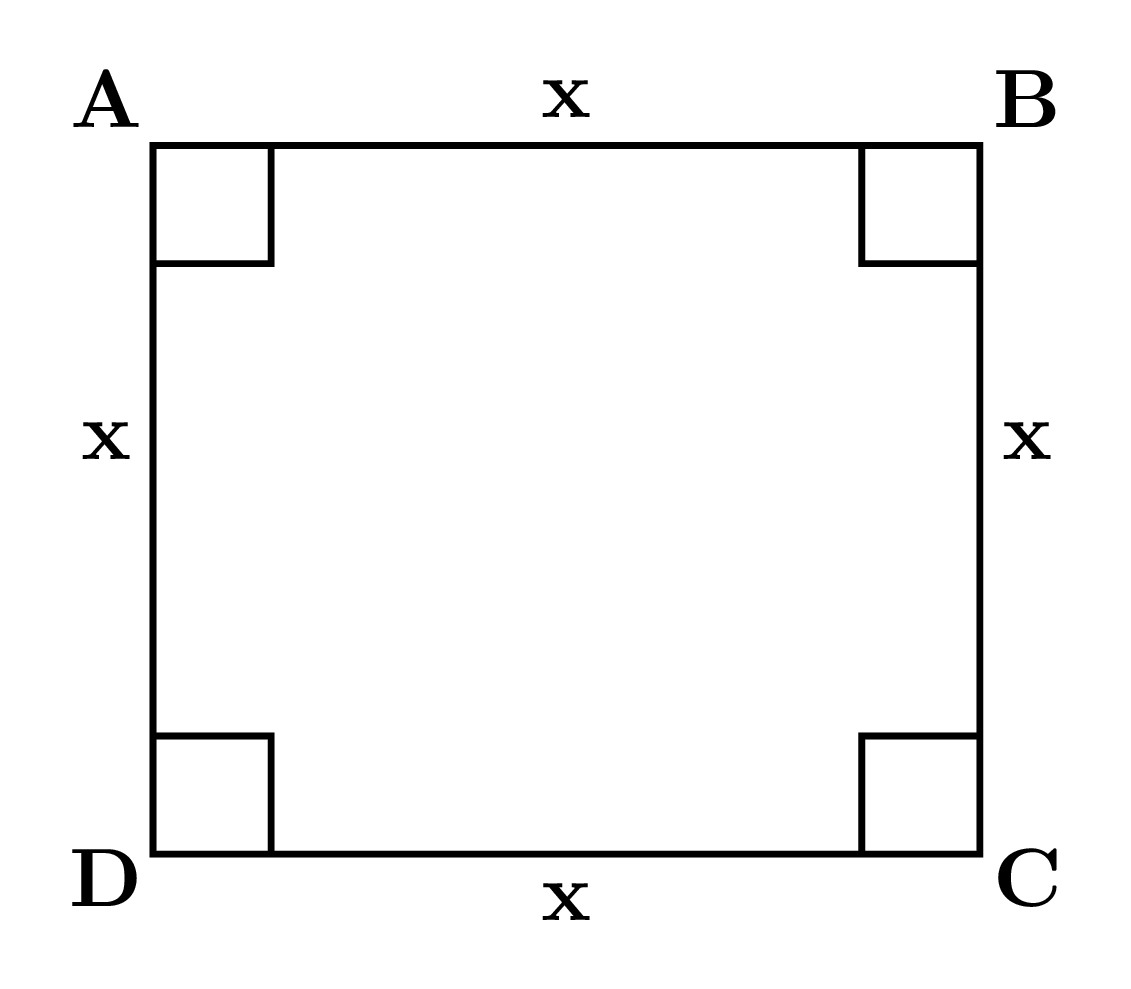
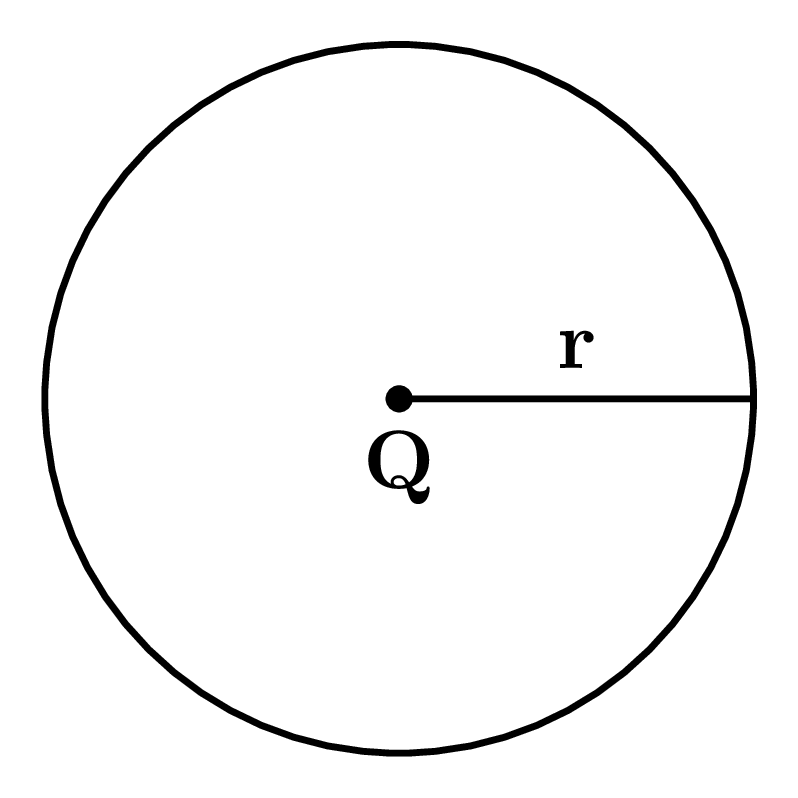
Let the side of an equilateral triangle, side of a square, the radius of a circle be $a,x,$ and $r$ respectively.

Now, $\frac{\sqrt{3}}{4}\; a^{2} = x^{2} = \pi r^{2} = k^{2}\;(\text{let})$

Now, 

  • $\frac{\sqrt{3}}{4}\; a^{2} = k^{2} \Rightarrow a^{2} = \frac{4k^{2}}{\sqrt{3}} \Rightarrow {\color{Blue}{\boxed{a = \frac{2k}{\sqrt{\sqrt{3}}}}}}$
  • $x^{2} = k^{2} \Rightarrow {\color{Purple}{\boxed{x = k}}}$
  • $\pi r^{2} = k^{2} \Rightarrow {\color{Teal}{\boxed{r = \frac{k}{\sqrt{\pi}}}}}$

Now, we can calculate the perimeter of each of that.

  • The perimeter of an equilateral triangle $ = 3a$
  • The perimeter of a square $ = 4x$
  • The perimeter of a circle $ = 2\pi r$

The ratio of the perimeters of the equilateral triangle to square to circle $ = 3a:4x:2\pi r$

$\qquad \qquad  = 3 \times \dfrac{2k}{\sqrt{\sqrt{3}}} : 4k:2 \pi \times \dfrac{k}{\sqrt{\pi}}$

$\qquad \qquad  = \dfrac{3}{\sqrt{\sqrt{3}}} \times \dfrac{\sqrt{\sqrt{3}}}{\sqrt{\sqrt{3}}} : 2: \sqrt{\dfrac{\pi ^{2}}{ \pi}}$

$\qquad \qquad  = \dfrac{3\;\sqrt{\sqrt{3}}}{\sqrt{3}} : 2: \sqrt{\pi}$

$\qquad \qquad  = \dfrac{3\;\sqrt{\sqrt{3}}}{\sqrt{3}} \times \dfrac{\sqrt{3}}{\sqrt{3}} : 2: \sqrt{\pi}$

$\qquad \qquad  = \sqrt{(3 \sqrt{3})}:2:\sqrt{\pi}$

Correct Answer $:\text{B}$


$\textbf{Important Points:}$

  • The area of an equilateral triangle ${\color{Green}{ = \dfrac{\sqrt{3}}{4}\;(\text{Side of an equilateral triangle})^{2}}}$

  • The area of a square ${\color{Lime}{ = (\text{Side of a square})^{2}}}$
  • The area of a circle ${\color{Cyan}{= \pi (\text{Radius})^{2}}}$
 

moved by

Related questions

4 4 votes
2 answers 2 answers
2.8k
2.8k views
Arjun asked Feb 15, 2022
2,773 views
A rhombus is formed by joining the midpoints of the sides of a unit square.What is the diameter of the largest circle that can be inscribed within the rhombus?$\dfrac{1}{...
11 11 votes
2 answers 2 answers
2.3k
2.3k views
Arjun asked Feb 15, 2022
2,279 views
The average of the monthly salaries of $\text{M, N}$ and $\text{S}$ is ₹$4000$. The average of the monthly salaries of $\text{N, S}$ and $\text{P}$ is ₹$5000$. The monthl...
5 5 votes
2 answers 2 answers
2.4k
2.4k views
Arjun asked Feb 15, 2022
2,360 views
A person travelled $80$ $\text{km}$ in $6$ hours. If the person travelled the first part with a uniform speed of $10$ $\text{kmph}$ and the remaining part with a uniform ...
9 9 votes
4 4 answers
2.8k
2.8k views
Arjun asked Feb 15, 2022
2,824 views
In a $12$-hour clock that runs correctly, how many times do the second, minute, and hour hands of the clock coincide, in a $12$-hour duration from $3$ PM in a day to $3$ ...

Related questions

4 4 votes
2 answers 2 answers
2.8k
2.8k views
Arjun asked Feb 15, 2022
2,773 views
A rhombus is formed by joining the midpoints of the sides of a unit square.What is the diameter of the largest circle that can be inscribed within the rhombus?$\dfrac{1}{...
11 11 votes
2 answers 2 answers
2.3k
2.3k views
Arjun asked Feb 15, 2022
2,279 views
The average of the monthly salaries of $\text{M, N}$ and $\text{S}$ is ₹$4000$. The average of the monthly salaries of $\text{N, S}$ and $\text{P}$ is ₹$5000$. The monthl...
5 5 votes
2 answers 2 answers
2.4k
2.4k views
Arjun asked Feb 15, 2022
2,360 views
A person travelled $80$ $\text{km}$ in $6$ hours. If the person travelled the first part with a uniform speed of $10$ $\text{kmph}$ and the remaining part with a uniform ...
9 9 votes
4 4 answers
2.8k
2.8k views
Arjun asked Feb 15, 2022
2,824 views
In a $12$-hour clock that runs correctly, how many times do the second, minute, and hour hands of the clock coincide, in a $12$-hour duration from $3$ PM in a day to $3$ ...
Position:
Show:
Answer:

Add Synced Question

×