• moved by
1,470 views

3 Answers

Best answer
9 9 votes

Given that $y_1 = x^{m}\;;\; 0\leq x \leq 1,\; m>1$

For simplicity we can take $m = 2,$ differentiate the function and get the slope.

For $y = x^{2}$ we get $m_1 = \frac{\mathrm{d} y }{\mathrm{d} x} = 2x.$

Similarly for $y_2 = x^{1/2}$ we get $m_2 = \frac{\mathrm{d} y }{\mathrm{d} x} = \frac{1}{2\sqrt x}$

At $x = 0, m_1 = 0, m_2 = \infty$

At $x = 1, m_1 = 2, m_2 = 0.5$ 

Only for option, A slope of $y_1$ is increasing and slope of $y_2$ is decreasing.
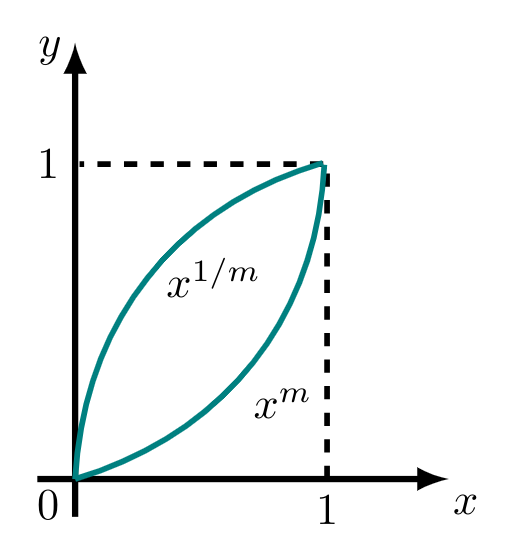
So, the correct answer is $(A).$

• edited by
1 1 vote
if we take x=0.5 and m=2 then we can see that y=x^m=0.25 where y=x^1/m=0.7 so from the given option we can eliminate the wrong option here.
so Option A is correct answer.
• moved by

Related questions

6 6 votes
2 answers 2 answers
1.7k
1.7k views
go_editor asked Feb 19, 2020
1,658 views
Define $[x]$ as the greatest integer less than or equal to $x$, for each $x\in \left (- \infty, \infty \right ).$ If $y = [x]$, then area under $y$ for $x\in \left [ 1,4 ...
21 21 votes
2 answers 2 answers
962
962 views
Arjun asked Feb 24, 2017
962 views
Which of the following curves represents the function $ln(|e^{[|\sin(|x|)]}|)$ for $\mid x\mid< 2\pi$? Here, $x$ represents the abscissa and $y$ represents the ordinate.
1 1 vote
4 answers 4 answers
1.6k
1.6k views
go_editor asked Feb 19, 2020
1,625 views
The sum of the first $n$ terms in the sequence $8,\:88,\:888,\:8888,\dots$ is ________.$\dfrac{81}{80}\left ( 10^{n}-1 \right )+\dfrac{9}{8}n \\$$\dfrac{81}{80}\left ( 10...
0 0 votes
0 0 answers
306
306 views
Arjun asked Feb 19, 2017
306 views
Let $f(x,y)=x^n y^m=P$ If $x$ is doubled and $y$ is halved, the new value of $f$ is$2^{n-m}P$$2^{m-n}P$$2(n-m)P$$2(m-n)P$

Related questions

6 6 votes
2 answers 2 answers
1.7k
1.7k views
go_editor asked Feb 19, 2020
1,658 views
Define $[x]$ as the greatest integer less than or equal to $x$, for each $x\in \left (- \infty, \infty \right ).$ If $y = [x]$, then area under $y$ for $x\in \left [ 1,4 ...
21 21 votes
2 answers 2 answers
962
962 views
Arjun asked Feb 24, 2017
962 views
Which of the following curves represents the function $ln(|e^{[|\sin(|x|)]}|)$ for $\mid x\mid< 2\pi$? Here, $x$ represents the abscissa and $y$ represents the ordinate.
1 1 vote
4 answers 4 answers
1.6k
1.6k views
go_editor asked Feb 19, 2020
1,625 views
The sum of the first $n$ terms in the sequence $8,\:88,\:888,\:8888,\dots$ is ________.$\dfrac{81}{80}\left ( 10^{n}-1 \right )+\dfrac{9}{8}n \\$$\dfrac{81}{80}\left ( 10...
0 0 votes
0 0 answers
306
306 views
Arjun asked Feb 19, 2017
306 views
Let $f(x,y)=x^n y^m=P$ If $x$ is doubled and $y$ is halved, the new value of $f$ is$2^{n-m}P$$2^{m-n}P$$2(n-m)P$$2(m-n)P$
Position:
Show:
Answer:

Add Synced Question

×