Four equilateral triangles are used to form a regular closed three-dimensional object by joining along the edges.
The shape formed will be a tetrahedron.
The angle between any two faces is
They are asking about dihedral angle (A dihedral angle is the angle between two intersecting planes or half-planes) of this tetrahedron.
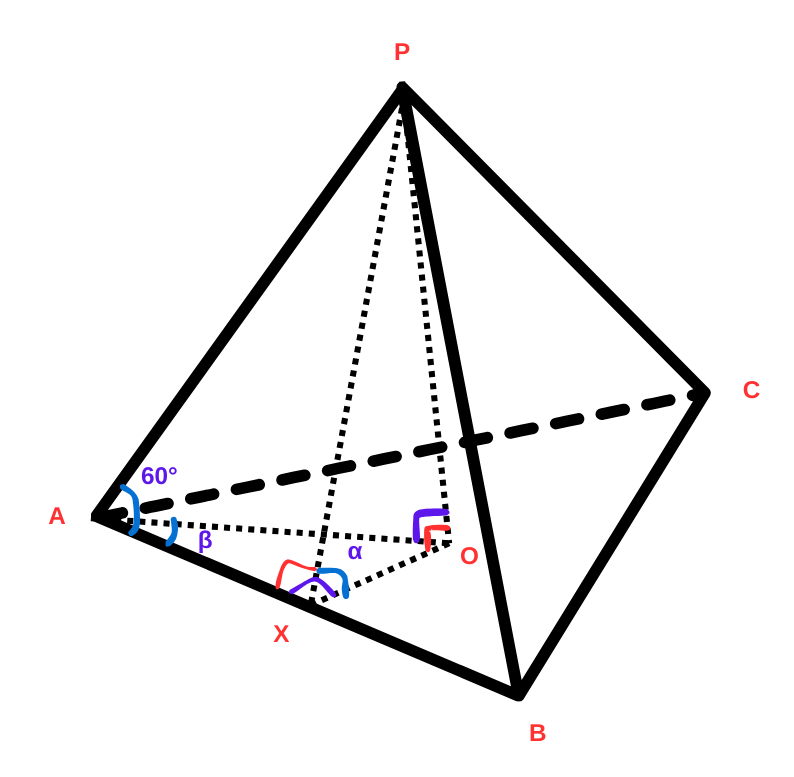
1. From the image:
- $\angle{POA} = 90^{\circ}$
- $\angle{POX} = 90^{\circ}$
- $\angle{AXO} = 90^{\circ}$
- $\angle{PXA} = 90^{\circ}$
- $\angle{PAB} = \angle{PAX} = 60^{\circ}$ ($\triangle PAB$ is equilateral traingle)
- $PA = PB = PC = AB = AC = BC = 1$ unit
I have choosen them this way so no proof is required here.
2. Now, we know within the equilateral $\triangle ABC$, the median $AO$ also serves as an angle bisector for angle $CAB$. This means that it splits the 60° angle at vertex A into two equal parts of 30° each. so, $\boxed{\beta = 30^{\circ}}$
3. $O$ is the center of triangle $\triangle ABC$ while $\angle{POA} = 90^{\circ}$ and $\angle{POX} = 90^{\circ}$. That's possible because all triangles are equilatral triangles and the symmetry of tetrahedron allows it.
4. $X$ is the mid-point of $AB$. So, $AX = XB = \frac{1}{2}$
5. Now, in $\triangle AXO$:
$tan(30^{\circ}) = \frac{OX}{AX}$
$\frac{1}{\sqrt{3}} = \frac{OX}{\frac{1}{2}}$
$\frac{1}{\sqrt{3}} \times \frac{1}{2} = OX$
$\boxed{\frac{1}{2 \sqrt{3}} = OX}$
6. Again, in $\triangle PXA$:
$tan(60^{\circ}) = \frac{PX}{AX}$
$\sqrt{3} = \frac{PX}{\frac{1}{2}}$
$\sqrt{3} \times \frac{1}{2} = PX$
$\boxed{\frac{\sqrt{3}}{2} = PX}$
7. Now, in $\triangle PXO$:
$cos(\alpha) = \frac{OX}{PX}$
$cos(\alpha) = \frac{\frac{1}{2 \sqrt{3}}}{\frac{\sqrt{3}}{2}}$
$cos(\alpha) = \frac{1}{2 \sqrt{3}} \times \frac{2}{\sqrt{3}}$
$cos(\alpha) = \frac{1}{3}$
$\alpha = cos^{-1}(\frac{1}{3})$
$\boxed{\alpha \approx 70.53^{\circ}}$

